Best-Before vs Use-By: Where UK Law Actually Draws the Line
- Compliance
- Food & drink
- Guides
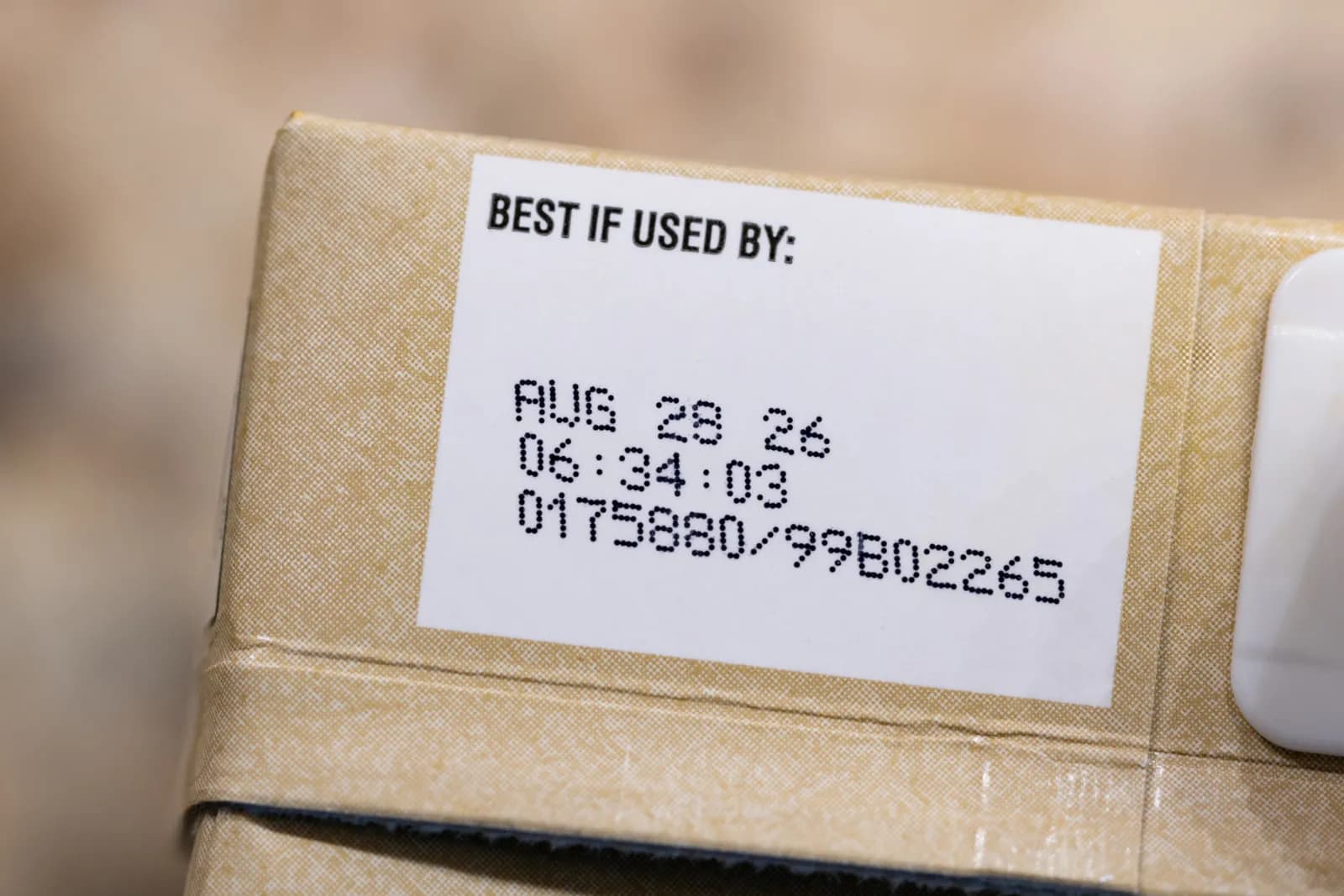
Two little phrases govern what happens to millions of tonnes of UK food every year, and they are routinely confused, by shoppers, by warehouse teams, and occasionally by the policies of businesses that should know better. The confusion is expensive. Here is the actual legal line, and what it means if you hold, sell or buy date-marked stock.
The two dates do different jobs
Use-by is about safety. It appears on microbiologically perishable food (fresh meat, fish, dairy, chilled ready meals) and marks the point after which the food may be unsafe even if it looks and smells normal. The Food Standards Agency's guidance is blunt: after the use-by date, food cannot be sold, and should not be eaten. There is one practical escape hatch: where the label permits, freezing before the date stops the clock, and the food can be used after thawing per the instructions.
Best-before (BBE) is about quality. It appears on ambient, frozen and long-life products (tins, dry goods, drinks, confectionery, most household-adjacent food) and marks the manufacturer's estimate of peak quality. After it, the biscuit may be marginally less crisp. Nothing in law prevents its sale, provided the food is still of acceptable quality when sold.
That asymmetry is the entire story. One date is a cliff with legal consequences; the other is a gentle slope with commercial ones.
What this means if you sell stock
For a business holding surplus, the date type determines the available exits:
- Past best-before: a lawful market exists. Value retailers, discount chains and exporters trade BBE-passed stock as their core business, with the original date clearly visible to the end customer. We buy best-before-expired stock by the pallet on exactly this basis, and the UK's surplus redistribution guidance (updated by WRAP, the FSA and Defra) explicitly accommodates it.
- Approaching use-by: the clock is real. Stock must be sold, donated and consumed, or frozen where permitted, before the date. This is where short-dated trading operates: compressed timelines, same-day pricing, collection booked around the code.
- Past use-by: no sale, no donation, no exceptions. The lawful routes are animal feed processing (for qualifying former foodstuffs, under APHA rules) or anaerobic digestion. Anyone offering to "move" past-use-by food into the human chain is proposing a crime; walk away.
Those are food rules, and they stop at the food. Household, cleaning and health and beauty lines carry dates that are mostly quality or batch conventions, so what the rules allow for out-of-date household and HABA stock is a looser question with a longer selling window behind it.
What this means if you buy stock
Buyers of clearance and surplus stock should read manifests with the same two-track logic. BBE-passed lines are legitimate inventory: confirm the original date is declared per line, condition is documented, and your own customers' expectations fit the offer. Use-by lines must arrive with workable life remaining; a reputable supplier states the exact code and dispatches accordingly. Every load offered to our surplus and clearance buyer list declares the date position of each line for precisely this reason, and the guide to reading a clearance pallet manifest covers what else a stock list should state before you reply to it.
Why so much legal stock gets binned anyway
UK households throw away significant amounts of food on or before its printed date, and businesses are not much more rational. WRAP's research has repeatedly found date-label confusion to be a major driver of avoidable waste, which is part of why the UK wastes roughly 10 million tonnes of food a year while best-before dates quietly disappear from fresh produce in several major retailers.
Inside businesses, the waste usually comes from policy conservatism rather than ignorance: brand standards that forbid any secondary sale, blanket rules that treat all dates as cliffs, or simple operational convenience (the skip asks no questions). Each of those choices destroys stock the law would happily let earn its way out of the building, and most of them would not survive contact with a written offer showing the stock's actual value. The scale of what is wasted while still edible is laid out in our report on food waste in the UK.
The practical checklist
- Sort surplus by date type before anything else. BBE and use-by stock have different buyers, timelines and legal exposure; a mixed manifest should say which is which per line.
- Never let use-by product cross its date in your custody if you can sell, donate or freeze it first. After the date your only compliant options cost money instead of making it.
- Don't write off BBE stock by reflex. Get a price first; the food and drink surplus guide covers what affects it.
- Document the route taken. Sale, donation, feed or AD: the waste-hierarchy paper trail is increasingly part of ESG reporting, and it is free to keep if you collect it as you go.
The line between the two dates is bright, legal and surprisingly profitable to respect. If date-marked stock is sitting on your racking while a policy debate decides its fate, send us the list. We aim to return a written offer within 24 hours, and a real number tends to settle the debate.
Frequently asked questions
Is it illegal to sell food past its best-before date in the UK?
No. Sale after a best-before date is lawful provided the food remains of acceptable quality. The date marks quality, not safety, and an established value-retail market trades this stock every day.
Is it illegal to sell food past its use-by date?
Yes. Use-by is a safety limit; food cannot lawfully be sold, redistributed or served after it, even if it looks and smells fine. Freezing before the date, where the label allows, stops the clock.
Why do retailers bin best-before stock if it is legal to sell?
Brand standards and range discipline, not law. That conservatism is exactly what creates the surplus market: compliant stock leaves the mainstream shelf long before it stops being sellable.