Food Waste in the UK: The Report
- Insights & reports
- Food waste
- Sustainability
The scale of the food waste crisis in the UK
The United Kingdom faces one of Europe's most significant food waste challenges, with 9.5 to 10.7 million tonnes of food wasted annually. This staggering amount would suffice to feed over 30 million people each year, yet 8.4 million people in the UK live in food poverty. The economic impact is equally devastating, with food waste costing the UK economy approximately £19 to £21.8 billion annually.
Where food waste occurs
Food waste in the UK originates from multiple sources across the entire food supply chain:
| Source | Share | Volume |
|---|---|---|
| Households | 60-70% | 6.4-6.7 million tonnes |
| On-farm | ~15% | 1.6 million tonnes |
| Manufacturing | 13-16% | 1.4 million tonnes |
| Hospitality & food service | 10-12% | 1.1 million tonnes |
| Retail | 2-3% | 0.2-0.3 million tonnes |
Remarkably, 67% of all UK food waste (6.4 million tonnes) was edible when discarded, indicating a massive potential for waste reduction through better management practices.
The most wasted foods in the UK
Analysis of food waste data reveals five key categories dominating UK waste streams:
| Food item | Annual waste | Key causes |
|---|---|---|
| Bread | 900,000 tonnes | Over-purchasing, storage issues |
| Potatoes | 750,000 tonnes | Aesthetic standards, overbuying |
| Milk | 490,000 tonnes | Short shelf life, portion misjudgment |
| Bananas | 190,000 tonnes | Over-ripening, cosmetic rejection |
| Salad & vegetables | 175,000 tonnes | Poor storage, retailer standards |
To put this in perspective, UK households waste the equivalent of 24 million slices of bread and 5.9 million glasses of milk daily.
Environmental impact
Food waste represents one of the UK's most significant environmental challenges, generating approximately 25 million tonnes of CO2-equivalent emissions annually, around 3-5% of the UK's total greenhouse gas emissions.
The methane problem
When food waste decomposes in landfill it produces methane, a greenhouse gas roughly 25 times more potent than CO2. This makes diverting food waste from landfill crucial for climate change mitigation.
Resource waste
Beyond emissions, food waste squanders the resources that produced it:
- Water footprint: 27 litres per capita daily for avoidable food waste.
- Land use: the equivalent of 0.33 square metres of cropland per tonne of food waste.
- Energy: everything spent on production, processing and transport is lost with the food.
Root causes of food waste
Understanding why food waste occurs is essential for developing effective reduction strategies.
Supply chain issues
- Overproduction and demand miscalculation.
- Aesthetic standards rejecting "imperfect" produce.
- Inadequate storage and handling infrastructure.
- Supply and demand mismatches in volatile markets.
Overproduction is where the gap between waste and surplus is widest. A run that overshoots its forecast, or a programme cancelled after the goods were made, leaves sound product with full date life and no order behind it. That is excess and overstock inventory, and it sells through the value channel rather than spoiling in a bay, provided the decision is taken while the codes are still long.
Consumer behaviour
- Over-purchasing and impulse buying.
- Poor meal planning and portion estimation.
- Best-before date confusion leading to premature disposal.
- Inadequate storage knowledge at home.
Industry practices
- Strict cosmetic standards set by retailers.
- Overstocking to ensure full shelves.
- Promotional offers that encourage excessive purchasing.
- Limited redistribution infrastructure.
Retail buying specifications add one more. A depot that refuses grocery inside the final stretch of its shelf life pushes lines out of the primary channel months before they stop being sellable, which is why selling short-dated stock is a working market rather than a salvage operation. The product is compliant and the buyers exist; what is missing is usually a decision, not a route.
Food waste to energy: the UK's growing solution
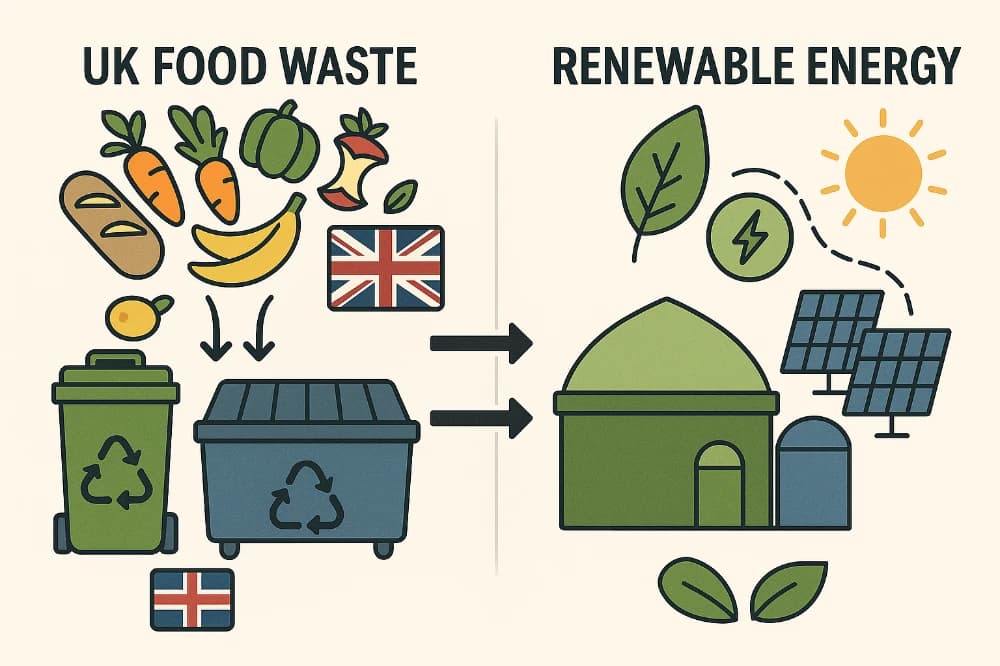
The UK has developed one of the world's most advanced food waste-to-energy sectors through anaerobic digestion (AD), which transforms organic waste into valuable resources while preventing harmful methane emissions.
How anaerobic digestion works
AD breaks down food waste in oxygen-free environments, producing two valuable outputs:
- Biogas: primarily methane, used for electricity generation or upgraded to biomethane.
- Digestate: nutrient-rich fertiliser for agricultural use.
Current UK capacity
- 730+ operational AD plants nationwide.
- 2,800+ MW of biogas capacity.
- 21 TWh of biogas produced annually.
- Enough biomethane to heat 4.5 million homes.
Despite this capacity, only 1.8 million tonnes of the UK's annual food waste is currently recycled through AD, indicating enormous untapped potential for energy recovery.
Food waste to animal feed: circular economy in action
Converting surplus food into animal feed is another crucial diversion strategy. The UK already processes 660,000 tonnes of former foodstuffs into animal feed annually, worth £110 million, and research indicates the potential to increase this to 800,000 tonnes.
The regulatory framework supports the route while ensuring safety:
- Foods past best-before dates can be used if quality is maintained.
- Use-by dated foods cannot be used unless frozen before expiry.
- Comprehensive traceability is required throughout the process.
- WRAP guidance provides a detailed compliance framework.
Best-before dates and food waste
Confusion around date labelling contributes significantly to UK food waste.
| Label type | Meaning | Post-date status |
|---|---|---|
| Use-by | Food safety date | Cannot be sold or consumed after (unless frozen before) |
| Best-before | Quality indicator | Safe to consume and legal to sell if stored correctly |
Research reveals widespread misunderstanding: many consumers treat best-before as a safety date and discard food on the printed date rather than by sensory assessment. Major retailers are responding by removing best-before dates from fresh produce, improving label clarity, and backing consumer education through Love Food Hate Waste campaigns.
This confusion is also where surplus brokers do their most direct work: stock that is past best-before but within use-by is legal, safe and sellable. That is exactly the inventory we buy. The same market takes the step before it too, because stock inside its final weeks of code life leaves the mainstream shelf while months of lawful selling life remain.
Business benefits of food waste reduction
- Financial: direct savings on purchasing and disposal, plus revenue from surplus sales.
- Environmental: carbon footprint reduction that counts towards net-zero targets.
- CSR: community engagement through redistribution, and a stronger brand with environmentally conscious consumers.
- Regulatory: compliance with mandatory food waste separation (Environment Act 2021), the Courtauld 2030 commitments and UN SDG 12.3.
The reporting side of that list has moved on quickly, and our CSR playbook for UK food and drink sets out which duties are now law, which frameworks are voluntary, and how recovered tonnage is counted.
Government initiatives and support
The UK government supports food waste reduction through WRAP (Waste & Resources Action Programme) and its Love Food Hate Waste campaign, operating since 2007 and credited with a 21% reduction in household food waste and £500 of food saved for every £1 invested.
The legislative direction is firm:
- Environment Act 2021: mandatory food waste separation for businesses.
- Simpler Recycling: universal food waste collection across England.
- Courtauld 2030 / UN SDG 12.3: halve per-capita food waste by 2030.
Implementing a reduction strategy
For businesses, effective food waste reduction follows a systematic approach:
- Target setting. Establish specific, measurable reduction targets aligned with industry commitments like Courtauld 2030.
- Measurement and monitoring. Track waste by SKU and site using WRAP's methodologies, and report progress regularly.
- Action planning. Fix root causes through process improvements, train staff, and build redistribution partnerships with companies such as Refresh Surplus. We also offer one-hour remote advisory calls; contact the desk to enquire.
The future of food waste management
The sector continues to evolve: AI-powered demand forecasting, smart freshness sensors, surplus redistribution platforms and expanding biogas capacity all point the same way. Food waste represents both a significant challenge and a tremendous opportunity for the UK. Through the combined efforts of businesses, government and consumers, this waste stream can become a resource stream. Companies like Refresh Surplus play a crucial role in that transformation, turning today's surplus into tomorrow's solutions.
Frequently asked questions
How much food does the UK waste each year?
Between 9.5 and 10.7 million tonnes annually across households, manufacturing, hospitality, retail and farms, costing the economy roughly £19 to £21.8 billion.
Is food past its best-before date wasted food?
No. Best-before is a quality indicator, not a safety limit. Food past best-before can legally be sold or redistributed in the UK if its quality remains satisfactory; only use-by dates are a hard safety line.
What is the most effective route for surplus food?
The UK food and drink waste hierarchy puts prevention first, then redistribution to people, then animal feed, then energy recovery such as anaerobic digestion, with disposal as the last resort.